Mercor AI Interview Preparation for Software Engineers
A practical rehearsal worksheet for explaining your own engineering work, plus the official practice, retake and AI-use rules to check before starting.
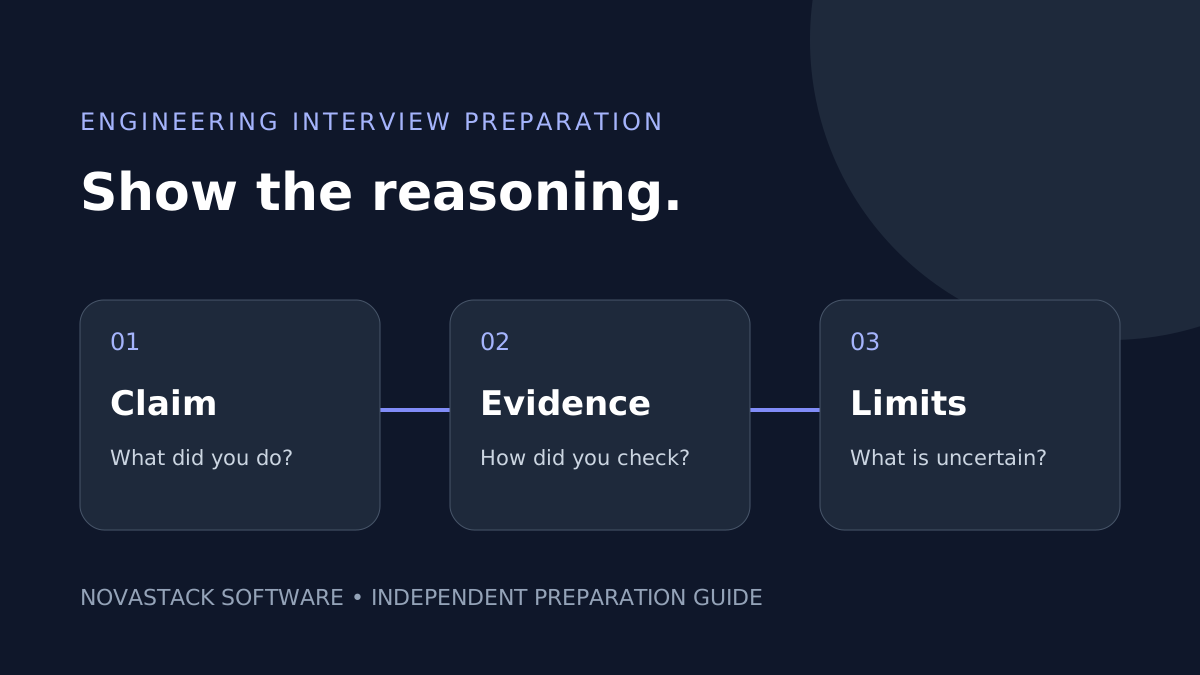
Preparing for a Mercor AI interview is not about memorizing a convincing script. For a software engineer, a better use of preparation time is making your own work easy to explain: what failed, what you changed, how you checked it, and where your knowledge stops.
This independent guide combines official public guidance checked on 12 November 2026 with an original rehearsal worksheet. It contains no real Mercor assessment questions, leaked material or model answers. NovaStack does not hire for Mercor, and preparation does not guarantee selection or paid work.
Check the format before practicing
According to Mercor's AI interview guide:
- Interviews are role-specific and usually take about 20 minutes, with variation.
- Its free practice interview is separate from applications, can be repeated and does not affect future opportunities.
- Chrome is recommended; Edge and Safari are supported, but Firefox is not. Some interviews require a computer, so do not assume your phone will work.
- Check your camera and microphone. Some interviews require full-screen sharing.
- Official interview retakes are limited to three across applications using that interview. A retake resets application progress, and hiring managers can see the count.
Read the current instructions in your own application. Practice mode and a limited official retake are not interchangeable.
Separate preparation from assessment assistance
Mercor's LLM usage policy permits limited grammar and wording support but prohibits using LLMs to supply explanations, evaluate model responses or predict code behavior. Its assessment rules also prohibit AI-generated answers, external copying and collaboration unless explicitly allowed.
Use this worksheet before an assessment to review your own experience, not as a live answer feed. Follow any stricter instructions shown for the particular assessment. Do not upload assessment questions, recordings or screenshots to an assistant for help. Mercor's internet-use policy also restricts sharing protected project and client material.
A 30-minute rehearsal you can do yourself
The timings below are our suggested practice routine, not Mercor requirements or a prediction of its interview. You need a timer, a blank page and one real engineering example you are allowed to discuss.
Minutes 0–5: pick one claim you can defend
Choose a specific statement from your experience. “Worked on React applications” is broad. “Investigated a checkout form that lost its error message after a second submission” gives you a concrete behavior to explain.
Do not choose the most impressive-sounding project automatically. Choose something where you can separate your contribution from the team's work and remember the decisions accurately. If the details are confidential, use a permitted, non-identifying description or a personal demonstration, clearly labeled as such.
Write three short notes:
| Note | What to record |
|---|---|
| Claim | The specific work you personally did |
| Evidence | A test, observation, public change or measurement that supports it |
| Boundary | What you did not own, did not measure or cannot disclose |
That last line is important. If someone else designed the service, say so. If you did not measure conversion, do not turn a UI fix into a claim about revenue.
Minutes 5–12: reconstruct the investigation
Walk through the example from the first symptom to the final check. Use these original rehearsal prompts, not as a predicted interview question list:
- What did you expect to happen, and what happened instead?
- Which observation helped you narrow the cause?
- What alternative explanation did you rule out, and how?
- What was the smallest change that addressed the cause?
- What check would fail if your explanation were wrong?
- What remained uncertain after the change?
For a UI bug, “I refreshed and it worked” is weaker evidence than checking the same sequence that originally failed. For an API incident, a successful request says little about retries or partial failure. For a performance change, record the conditions of the measurement rather than calling something “much faster.”
Minutes 12–20: explain it aloud, then shorten it
Give a two-minute explanation without reading a prepared paragraph. This is a rehearsal constraint, not a required answer length. Start with the problem and your contribution, then explain the decision and the evidence.
Listen for places where a listener would have to guess. What does “optimized the state” actually mean? Which state, which transition and which observed problem? Replace vague labels with a concrete mechanism.
Now try a shorter version while retaining the important limitation. The goal is not to sound polished at any cost. It is to make the reasoning understandable without burying the central point under framework names.
Minutes 20–25: change one assumption
Ask yourself how the solution behaves under one different condition. For the checkout example, try a repeated submission, a failed response or navigation away before completion. For a background job, consider a restart between sending a request and saving its result.
You do not need to pretend you solved every scenario. Separate what you know from what you would investigate next. A useful answer identifies the missing evidence and the check you would run, rather than inventing an outcome.
Minutes 25–30: check the practical setup
Schedule a separate session with Mercor's own practice option to familiarize yourself with its interface; it is not part of this five-minute setup check. Before an official attempt, arrange a quiet space and close unrelated private material. If full-screen sharing is requested, check what the entire screen exposes, not just the active tab.
Keep your resume accurate and consistent with what you can explain. Stop practicing before you start reciting sentences mechanically. A rehearsal should make your understanding clearer, not create a performance you cannot adapt when the conversation changes.
What this routine cannot tell you
This is not a scoring rubric or a way to predict your result. Mercor's assessment documentation says evaluation can vary by listing, even when assessments are shared. Completing an assessment is not an offer.
Before investing time, check the actual opportunity's location, workload, engagement terms and status. A standing talent pool is not an immediate vacancy. Our Mercor engineering role-fit guide covers those checks and a separate portfolio exercise.
If a technical problem occurs, use the help options in the official interface and consult Mercor's support guidance. Do not repeatedly consume official attempts just to practice. Keep any diagnostic material for Mercor's authorized support channel, not a public post.
Optional referral, not a hiring shortcut
Anup may receive a reward if an eligible referral through his personal link meets Mercor's referral terms. A click or completed interview alone does not establish a payable referral. The link does not bypass eligibility or assessment requirements. The direct Explore option below works without using Anup's referral.